If you’ve ever walked a construction site for a municipal water main project, a large-scale industrial chemical transfer facility, or even a rural natural gas distribution line, chances are you’ve seen PE (polyethylene) buttfusion fittings. As a supplier who’s been on the front lines of bringing these fittings to projects across North America for 12 years, I’ve heard every question imaginable about their use—and one that pops up more often than I’d expect is: “Can PE buttfusion fittings handle high-pressure applications?” PE Buttfusion Fittings
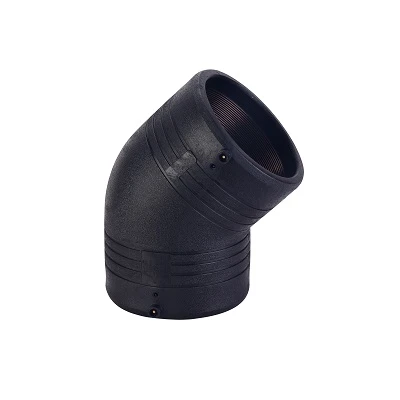
I get it. For decades, metal fittings ruled the space for high-pressure jobs, and switching to a plastic material like PE can feel like a risk. Metal has a track record of withstanding the intense forces of pressurized fluids, and many people assume plastic can’t keep up. But over the years, I’ve worked with engineers, project managers, and tradespeople who’ve pushed PE buttfusion fittings into pressure applications that most of us would have deemed impossible 20 years ago. Today, I want to break down what high-pressure really means, how PE buttfusion fittings perform under pressure, the limits you need to know, and when they’re actually the best choice for a pressurized job.
First, let’s define what we mean by “high-pressure applications” because that term is often vague. For plumbing and residential jobs, “high pressure” might mean 80 to 100 PSI (pounds per square inch)—standard for home water lines. But for industrial or municipal large-scale projects, high pressure can start at 150 PSI and go up to 230 PSI or even higher for specialized jobs like oil and gas gathering lines or large-diameter water transmission mains. That range matters because PE’s performance under pressure depends on two key factors: the grade of PE resin used and the design of the buttfusion fitting itself.
Let’s talk about PE grades first. Not all PE is created equal. The PE used for buttfusion fittings is categorized by its density and molecular weight, and that directly impacts pressure rating. The most common grade for pressurized applications is PE 100—you might also see it written as PE 100-RC, which stands for “Resistance to Crack growth.” PE 100 is a high-density polyethylene with a minimum required strength (MRS) of 10 MPa, a standard set by organizations like ISO and ASTM. That MRS is a measure of how much stress the material can handle over a 50-year period—critical for applications that need to last decades without failing. Compare that to the older PE 80 grade, which has an MRS of 8 MPa, and you can see why PE 100 has become the go-to for pressure jobs. PE 100-RC is even better for high-stress areas because it resists slow crack growth, which is a common failure point when fittings are under constant pressure, especially if they’re exposed to soil stress or sharp edges during installation.
Now, how does that translate into actual working pressure? A PE buttfusion fitting’s pressure rating isn’t just a random number—it’s calculated using a formula that accounts for the pipe’s outside diameter, wall thickness, and the material’s MRS. For example, a SDR 11 (Standard Dimension Ratio, meaning wall thickness is 1/11 of the outside diameter) PE 100 pipe has a working pressure of around 150 PSI, while SDR 9 goes up to 180 PSI, and SDR 7.4 can hit 230 PSI. That’s not a fluke—those numbers are validated through rigorous testing that simulates 50 years of pressure cycling, temperature changes, and environmental exposure. When we manufacture our PE buttfusion fittings, we use the same resin and wall thickness standards as the matching pipe, so the fitting’s pressure rating matches the pipe it’s paired with. That means if you’re using SDR 7.4 PE 100 pipe for a 200 PSI application, our buttfusion fittings will hold up to that same pressure.
But wait—what about higher pressures? I’ve had engineers ask me about 300 PSI or more, and that’s where it gets nuanced. Traditional PE buttfusion fittings aren’t designed for pressures that high, but there are specialized applications where they can work. For example, some industrial process lines that handle non-corrosive fluids at moderate temperatures use thicker-walled custom PE fittings rated for up to 270 PSI, though that’s not a standard off-the-shelf product. The key here is temperature: PE’s strength drops as temperature rises. At 73°F (room temperature), PE 100 retains 100% of its MRS, but at 100°F, that drops to around 80%, and at 140°F, it’s down to about 60%. So a fitting rated for 230 PSI at 73°F is only good for around 138 PSI at 140°F. That’s a critical point I always drive home with customers—pressure ratings are temperature-dependent, so you can’t just take a number from a cold-application chart and apply it to a hot industrial job.
Now, let’s talk about the unique benefits of PE buttfusion fittings in pressure applications, because it’s not just about whether they can work—it’s about when they’re a better choice than metal. First, corrosion. Metal fittings, especially steel or iron, corrode over time, especially when paired with acidic or mineral-rich water. I’ve seen a 10-inch steel water main fail at a joint after 15 years due to internal corrosion, while a neighboring PE buttfusion joint in the same line lasted 40 years with zero issues. For pressurized lines that need to stay leak-free for decades, corrosion resistance is a huge win. PE is also lightweight—10-inch PE pipe is a fraction of the weight of steel, so installing fittings and pipe is faster and requires less heavy equipment, which cuts down on labor costs. That’s a big deal for municipal projects that have tight timelines and budgets.
Another benefit is flexibility. PE buttfusion fittings can bend a small amount without breaking, which makes them ideal for applications where the ground might shift slightly—like areas with freeze-thaw cycles or expansive soil. Metal fittings are rigid, so if the ground shifts, the joint can crack under pressure. I worked on a project in Minnesota a few years ago where a metal water line had repeated joint failures due to frost heave. We swapped in PE buttfusion fittings, and they’ve held up for 8 years without a single leak—something the project team had never experienced with metal.
But I’d be doing a disservice if I didn’t talk about the limitations, because PE buttfusion fittings aren’t right for every high-pressure application. First, they’re not designed for very high pressures—anything above 250 PSI consistently is better suited for metal or specialty high-performance plastics like PVDF. They also have temperature limits, as I mentioned earlier—if you’re working with hot fluids over 140°F, you need to use a higher-grade PE or consider another material. Installation matters too. PE buttfusion fittings only perform as well as the fusion joint. If the installer doesn’t follow the proper steps—cleaning the ends, heating to the right temperature, applying the correct pressure, and letting it cool properly—you’ll get a weak joint that can fail under pressure. I always tell customers to work with experienced fusion technicians, and we even offer on-site training to make sure joints are installed correctly.
Let me share a real example that comes to mind. A food processing plant reached out to me a few years ago, needing to replace metal fittings in their compressed air line that kept corroding and causing downtime. Their line ran at 120 PSI, which is well within the range of standard PE 100 buttfusion fittings. We paired our SDR 11 PE buttfusion fittings with matching pipe, and they installed it over a weekend, avoiding costly production downtime. Two years later, the plant maintenance manager told me that line had zero issues, while the old metal line required monthly repairs. That’s the kind of win I see all the time when PE buttfusion fittings are used in the right high-pressure application.
Another example is a rural natural gas distribution project. Many gas utilities are switching to PE because it’s resistant to gas permeation in small amounts, and buttfusion joints are seamless, so there’s no risk of leaks at the fitting. A lot of these lines run at 125 PSI, which is well within PE’s pressure range. I’ve supplied fittings for gas projects across the Midwest, and the data shows that PE buttfusion joints have a failure rate of less than 0.1% over 50 years, compared to around 1.2% for steel fittings in the same applications. That statistic is what makes utilities trust PE more and more for their pressurized lines.
So, to circle back to the original question: Can PE buttfusion fittings be used for high-pressure applications? The answer is yes—when you’re working within the correct pressure, temperature, and material specifications. Standard off-the-shelf PE 100 buttfusion fittings are ideal for pressures up to 230 PSI at room temperature, which covers most municipal water mains, industrial process lines, gas distribution lines, and irrigation systems. Specialized grades and custom fittings can go higher, but only up to a point. The key is understanding the application’s specific requirements, choosing the right PE grade and SDR rating, and making sure the fusion joints are installed correctly.
As a supplier, my job isn’t just to sell fittings—it’s to help customers make the right choice for their project. I’ve seen too many people write off PE because of outdated assumptions, or use it in a situation where it’s not the right fit. That’s why I always start with a conversation: what’s the pressure, what’s the temperature, what fluid are you moving, what’s the installation environment? That way, I can recommend not just whether PE buttfusion fittings will work, but also what grade and design will give you the longevity and performance you need.

If you’re working on a project that involves pressurized lines and you’re considering PE buttfusion fittings, or you have questions about whether they’re right for your application, I’m here to help. We’ve supplied fittings to thousands of projects across the country, from small residential jobs to large municipal infrastructure builds, and we have the technical expertise to walk you through every step. Whether you need a quote for standard fittings, custom-designed parts, or training for your installation team, we can work with you to find the solution that fits your needs. Don’t let outdated assumptions hold your project back—reach out to us to discuss your requirements and let’s make sure your pressurized line is safe, reliable, and built to last.
PE Steel Transition Fittings References:
- American Society for Testing and Materials. Standard Specification for Polyethylene (PE) Plastic Pipe (SDR-PR) Based on Controlled Outside Diameter. ASTM D3350-22, 2022.
- International Organization for Standardization. Plastics — Polyethylene (PE) pipes and fittings for gas supply and water supply — Specifications. ISO 4427:2019, 2019.
- Plastics Pipe Institute. PE Pipe Handbook: Design, Installation, and Operation. 7th ed., Plastics Pipe Institute, 2021.
- American Water Works Association. PE Pressure Pipe for Water Distribution and Transmission. AWWA M55, 2020.
Zhejiang Shengbo Pipe Fittings & Valves Industry Co., Ltd.
With abundant experience, we are one of the most professional pe buttfusion fittings manufacturers and suppliers in China. Please feel free to buy discount pe buttfusion fittings from our factory. Welcome to contact us for quotation and free sample.
Address: No. 79 Hemudu North Road, Hemudu Town, Yuyao City, Ningbo City, Zhejiang Province, China
E-mail: shengbo@zj-shengbo.com
WebSite: https://www.shengbofitting.com/
